Wondering whether a single-family rental or a small multi-family property makes more sense in Norman? It is a smart question, especially in a city where university-driven demand, neighborhood-specific zoning, and changing vacancy patterns can all shape your return. If you are weighing your next investment move, this guide will help you compare costs, financing, management, and location factors so you can make a more confident decision. Let’s dive in.
Why Norman Looks Different
Norman is not just another suburb. It is the third-most populous city in Oklahoma and home to the University of Oklahoma’s main Norman campus, which creates a local housing market with its own rhythm.
That matters because rental demand in Norman is influenced by more than standard job and population trends. OU reported a systemwide enrollment above 36,500 students in fall 2025, and its 2025 freshman class set a state record. In practical terms, that can translate into seasonal leasing, roommate turnover, and stronger rental demand in some areas than you might expect in a typical suburban market.
At the same time, Norman is active without being extremely tight. Redfin reported a median sale price of $281,831 in May 2026, with 35 median days on market and 508 homes sold. Census QuickFacts lists a 53.3% owner-occupied housing unit rate, a $250,100 median owner-occupied home value, and $1,090 median gross rent, while Zillow’s rent tracker placed average rent at $1,495 in early July 2026.
Single-Family vs Small Multi-Family
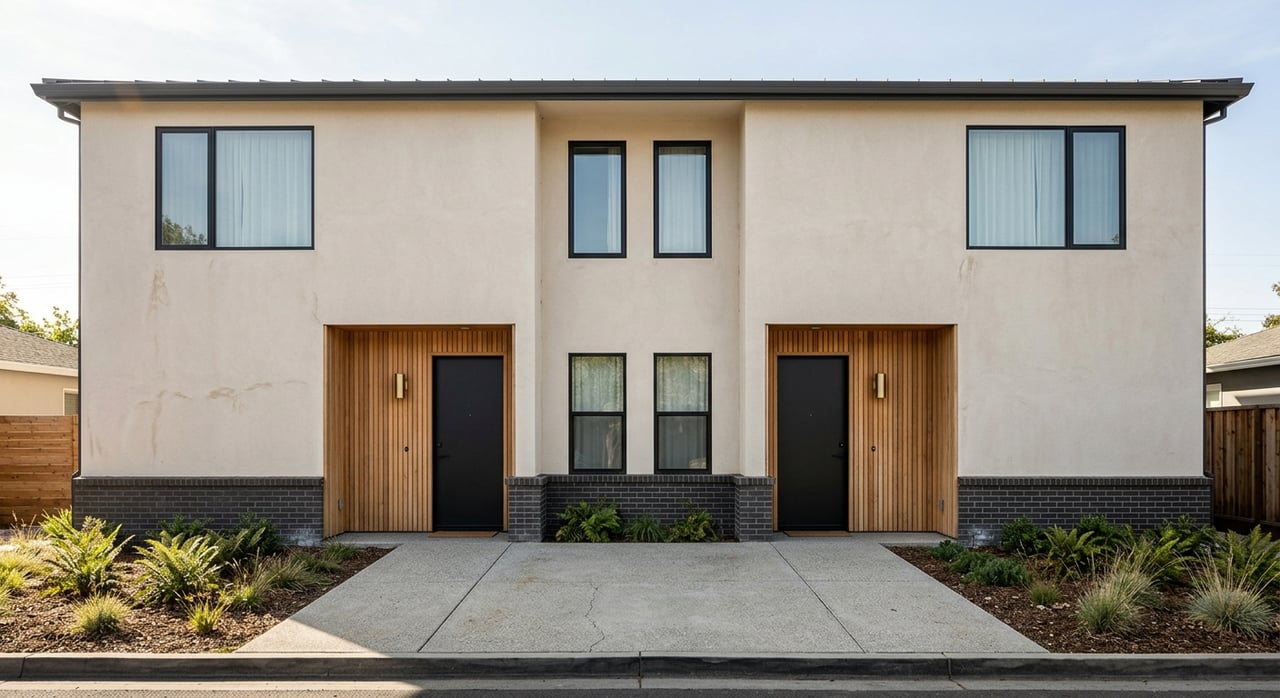
For most local investors, “small multi-family” usually means a 2- to 4-unit property. That distinction matters because financing rules, down payment requirements, and operating demands change meaningfully once you move beyond one unit.
A single-family rental is typically easier to buy, easier to finance, and easier to manage. A small multi-family property can offer more than one income stream under one roof, but it often requires more cash up front and more hands-on oversight.
Here is the simplest way to think about it:
- Single-family often fits investors who want a lower entry cost and simpler operations.
- 2-4 unit multi-family often fits investors who want income diversification and can handle more complexity.
Upfront Cost Can Be the Deciding Factor
In Norman, the biggest difference between these two paths may be your cash-to-close. Based on current residential investment lending guidelines, a 1-unit investment purchase can go up to 85% loan-to-value, while a 2- to 4-unit investment purchase is typically capped at 75% loan-to-value.
Using Norman’s median sale price of $281,831, that works out to an estimated down payment of about $42,275 for a single-family investment purchase and about $70,458 for a 2- to 4-unit investment purchase, before closing costs. That is a meaningful gap for any buyer trying to preserve cash for repairs, reserves, or vacancy.
Closing costs are separate and typically add another 2% to 5% of the purchase price. On Norman’s current median sale price, that means about $5,637 to $14,092. A rough illustration puts total cash to close around $47,911 to $56,366 for a 1-unit investment property and $76,094 to $84,549 for a small multi-family investment property, before repairs or holdbacks.
Owner-Occupant Financing Changes the Math
If you plan to live in one unit, the equation can shift. HUD states that FHA financing is available for 1- to 4-unit properties with down payments as low as 3.5%, as long as the buyer will occupy the property.
That makes a duplex, triplex, or fourplex potentially more accessible if your strategy is to house hack rather than buy as a pure investor. In that case, small multi-family may become less of a cash hurdle than it looks at first glance.
Still, this is not the same as buying a standard investment property. Occupancy requirements matter, and underwriting can still be more detailed on multi-unit properties. It is important to review the actual financing path before deciding that multi-family is the clear winner.
Income Stability vs Simplicity
One of the biggest reasons investors choose small multi-family is income diversification. If one unit goes vacant in a duplex or triplex, the property may still produce income from the remaining unit or units.
A single-family rental does not offer that same cushion. If your one tenant moves out, your rental income typically drops to zero until the next lease begins.
But the tradeoff is operational simplicity. Single-family rentals usually mean one lease, one household, and one main set of systems to track. With a 2- to 4-unit property, you may be managing multiple leases, more turnover events, and shared maintenance issues across units.
Vacancy Matters in Norman
Norman’s local housing strategy report shows why vacancy should stay front and center in your underwriting. The city reported a 9.1% vacancy rate in 2020 and 7.3% in 2021, and noted that more than 80% of 2020 vacancies were rentals.
The same report also said that more than 34% of estimated vacancies in 2022 were vacant for “other reasons.” The key takeaway is that Norman’s rental market is not driven by demand alone. Churn, timing, and property-specific factors can all affect your real-world performance.
This is where the property type matters. A single-family rental in a more owner-occupied setting may behave differently from a smaller multi-family property in an area more exposed to student move-in and move-out cycles.
The University Effect Is Real
Because Norman is home to OU, some parts of the rental market behave more like a college market. Large student populations often create annual lease resets, roommate changes, and heavier seasonal turnover.
That does not automatically make small multi-family better or worse. It means you should evaluate tenant profile and location carefully. A property near campus may see stronger renter demand, but it may also come with more frequent lease changes and more management intensity.
By contrast, some single-family rentals may appeal to longer-term households and feel more stable operationally. Neither path is universally better. In Norman, the better choice often depends on the block, the tenant base, and your tolerance for hands-on management.
Zoning Can Make or Break the Deal
This is one of the most important parts of investing in Norman. You cannot assume a parcel will work for a duplex, triplex, or fourplex just because the building looks like a fit or the area feels rental-friendly.
Norman’s zoning code separates R-1 single-family, R-2 two-family dwelling, and RM-2 low-density apartment districts. The city states that R-2 allows a duplex or a single-family dwelling with a garage apartment, while RM-2 is intended for low-density multi-family housing that is compatible with nearby single-family and two-family development.
That means zoning review should happen early, before you build a pro forma around extra units or a conversion idea. In Norman, the legal use of the property is not a detail to check later. It is part of the first-pass analysis.
Overlays Add Another Layer
Neighborhood overlays can also change what is practical. In the Old Silk Stocking area, the city notes that the Central Norman Zoning Overlay District was created in response to redevelopment pressure tied to student housing.
In that overlay, residential units with four or more bedrooms require special use permit approval. That does not just affect large homes. It can also influence how you evaluate rental strategy, occupancy assumptions, and future exit options.
This is why “small multi-family in Norman” is not a one-size-fits-all category. The address, zoning district, and overlay status all matter.
When Single-Family Often Makes Sense
Single-family can be a strong fit if your goal is straightforward ownership with fewer moving parts. It often works well for investors who want a lower down payment requirement, simpler maintenance, and potentially broader resale appeal later.
In Norman, single-family may be especially appealing if you want to avoid heavy turnover or if you prefer neighborhoods where the rental rhythm is less tied to the academic calendar. It can also be easier to underwrite because there is usually one lease structure and a more familiar buyer pool on resale.
Single-family may be the better fit if you value:
- Lower upfront cash needs compared with 2- to 4-unit investment purchases
- Simpler property management
- Easier financing structure
- Potentially smoother resale liquidity
When Small Multi-Family Often Makes Sense
A 2- to 4-unit property can make sense if you want multiple rent streams from one address and you are comfortable with a more detailed underwriting process. It may also appeal to buyers who want to live in one unit and use owner-occupant financing.
In Norman, small multi-family can be compelling in areas where renter demand is steady and the zoning clearly supports the use. The value proposition often comes down to diversification. One vacancy may hurt less when the property still has occupied units producing income.
Small multi-family may be the better fit if you want:
- More than one income stream from one property
- A possible owner-occupant FHA path on 1- to 4-unit housing
- A strategy built around rental density rather than simplicity
- Flexibility to spread vacancy risk across multiple units
A Smart Decision Framework for Norman
Before you choose one path, pressure-test the deal from several angles. In Norman, returns are shaped by more than purchase price and rent estimates.
Focus on these questions:
- What is the zoning for this exact parcel?
- Is there an overlay district that affects the property?
- How much cash will you need beyond down payment and closing costs?
- How seasonal is renter demand in this specific area?
- Are your rent assumptions based on comparable properties nearby?
- Can you comfortably manage turnover, maintenance, and vacancy risk?
A good investment in Norman usually starts with specifics, not general rules. The right answer is often less about whether single-family or small multi-family is “better” and more about whether the property fits your capital, financing plan, and management style.
If you want help comparing Norman opportunities, underwriting rent potential, or reviewing zoning and financing considerations before you write an offer, Tracy Murrell can help you build a strategy that fits your goals.
FAQs
What is considered small multi-family in Norman real estate investing?
- For this type of comparison, small multi-family usually means a 2- to 4-unit property.
How much more cash do you usually need for a Norman small multi-family investment?
- Based on current lending guidelines and Norman’s median sale price, a 2- to 4-unit investment property typically requires a larger down payment than a single-family investment property, plus separate closing costs.
Can you use FHA financing for a Norman duplex or fourplex?
- Yes, FHA financing can apply to 1- to 4-unit properties if you will occupy one of the units and meet program requirements.
Why does zoning matter for Norman multi-family investing?
- Norman’s zoning code separates single-family, two-family, and multi-family districts, so you need to verify the property’s exact zoning before assuming a multi-unit strategy will work.
Does the University of Oklahoma affect Norman rental demand?
- Yes, OU’s large student population can influence seasonal leasing patterns, roommate turnover, and annual lease resets in some parts of Norman.
Is single-family or small multi-family easier to manage in Norman?
- In most cases, single-family is simpler to manage because it usually involves one lease, one household, and fewer unit-specific turnover events.